

You were injured in an accident. You know the other driver was at fault. You filed a claim, and now the insurance adjuster is calling, not to offer you a fair settlement, but to ask a series of very specific questions. Were you speeding? Did you check your mirrors before changing lanes? Were you distracted? These questions aren’t casual conversation. They’re a calculated strategy designed to shift blame onto you and exploit one of the most powerful legal tools in the insurance industry’s playbook: Texas comparative fault law.
Understanding how this law works and how it can be used against you is one of the most important things you can do to protect your injury claim. In Texas, the difference between recovering full compensation and walking away with nothing can come down to a single percentage point.

Key Takeaways
-Texas follows a modified comparative fault rule, meaning your compensation is reduced by your percentage of fault
-If you are found 51% or more at fault, you recover nothing, regardless of how serious your injuries are
-Insurance adjusters are trained to push your fault percentage past that 51% threshold from the moment you file a claim
-Recorded statements, social media posts, and delayed medical treatment are all used to increase your assigned fault
-Fault percentages are not final; they can be challenged with the right evidence and legal representation
-The sooner you have a Dallas accident attorney involved, the harder it is for the insurance company to manipulate the fault narrative
What Is Texas Comparative Fault Law? (And Why It Matters for Your Injury Claim)
Texas follows a legal standard known as modified comparative fault, sometimes called proportionate responsibility. Under this rule, each party involved in an accident is assigned a percentage of fault based on their contribution to the incident. Your ability to recover compensation depends entirely on where your percentage lands.
If you are found to be 50% or less at fault, you can recover damages, but your compensation will be reduced by your percentage of fault. If you are found to be 51% or more at fault, you are completely barred from recovering anything at all. This is the 51% rule, and it is the legal threshold that insurance companies target every single time they handle a Texas injury claim.
Here’s a simple example. Suppose you were injured in a car accident and your total damages, medical bills, lost wages, pain and suffering, amount to $100,000. If a jury finds you 20% at fault, you recover $80,000. If they find you 40% at fault, you recover $60,000. But if they find you 51% at fault, you recover zero. Not a reduced amount. Nothing.
Texas 51% Fault Rule: How Compensation Changes Based on Your Fault Percentage
| Your Assigned Fault | Total Damages | Amount You Can Recover |
| 0% | $100,000 | $100,000 |
| 20% | $100,000 | $80,000 |
| 40% | $100,000 | $60,000 |
| 50% | $100,000 | $50,000 |
| 51% | $100,000 | $0 |
That one-percent difference between 50% and 51% is not a legal technicality. It is a financial cliff, and insurance companies know exactly where the edge is.
How Insurance Companies Manipulate Fault Percentages to Deny Texas Injury Claims
Insurance adjusters are not neutral parties. They work for the insurance company, and their job is to minimize payouts. The 51% rule gives them a powerful incentive to build a case against you from the moment you file a claim. The goal isn’t necessarily to prove you were entirely at fault, it’s simply to push your percentage past that 51% threshold.
They do this in several deliberate ways. The recorded statement is one of the most common traps. When an adjuster calls and asks to record your account of the accident, they’re listening for anything that can be used to assign you more fault. A simple statement like “I didn’t see them coming” can be reframed as evidence of inattentiveness. “I was in a hurry” can become evidence of reckless driving. You are not required to give a recorded statement to the other driver’s insurance company, and doing so without legal guidance is rarely in your best interest.
Adjusters also conduct their own investigations, often before you’ve had a chance to gather evidence. They’ll review traffic camera footage, speak with witnesses, and analyze the accident scene, all to build a narrative that increases your share of fault. By the time they make you an offer, they’ve already done the math.
Social media is another tool in their arsenal. Photos of you at a social event, a post about your weekend plans, or even a comment from a friend can be used to suggest that your injuries aren’t as serious as you claim or that your behavior contributed to the accident. The investigation into your fault doesn’t stop at the accident scene.
Why Comparative Fault Disputes Are So Common in Texas Personal Injury Cases
Because the stakes of the 51% threshold are so high, fault disputes are a routine part of nearly every Texas personal injury case. Multi-vehicle accidents, intersection collisions, and accidents involving lane changes or merges are particularly vulnerable to comparative fault arguments because the sequence of events is often unclear and open to interpretation.
Even cases that seem straightforward can become complicated. A rear-end collision, typically considered the following driver’s fault, can be challenged if the insurance company argues that you braked suddenly without cause. A slip and fall on someone else’s property can be contested if the property owner claims you ignored visible warning signs. The 51% rule gives every defendant and their insurer a reason to fight, because crossing that threshold means paying nothing.
What Evidence Determines Fault Percentage in a Texas Personal Injury Case
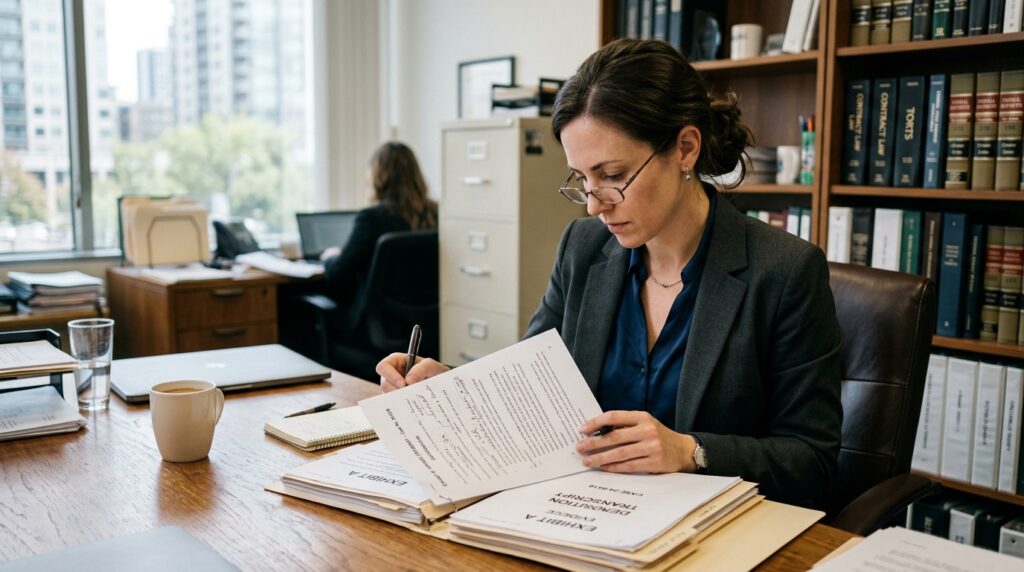
Fault percentages don’t come from thin air. They’re determined by the evidence presented, and the quality of that evidence matters enormously. Police reports, surveillance footage, witness statements, accident reconstruction analysis, and medical records all play a role in establishing what happened and who bears responsibility.
| Type of Evidence | What It Establishes | Why It Matters |
| Police Report | Official account of the accident | Carries significant weight in fault determination |
| Surveillance Footage | Visual record of the incident | Difficult to dispute, shows sequence of events |
| Witness Statements | Third-party account of what happened | Corroborates your version of events |
| Accident Reconstruction | Technical analysis of the crash | Counters insurance company narratives |
| Medical Records | Documents injuries and their cause | Connects the accident to your damages |
| Cell Phone Records | Shows distraction at time of accident | Can be used for or against either party |
The party with better evidence almost always ends up with a lower fault percentage. This is why preserving evidence immediately after an accident is so critical. Surveillance footage gets overwritten. Witnesses become harder to locate. Physical evidence at the scene disappears. Every day that passes without proper documentation is a day that works in the insurance company’s favor.
How to Protect Your Texas Injury Claim From Unfair Fault Shifting
The most effective way to protect yourself from having fault unfairly shifted onto you is to be proactive from the very beginning. At the scene of the accident, document everything you can: photos of all vehicles, the road conditions, traffic signals, skid marks, and any visible injuries. Get the names and contact information of witnesses before they leave.
Seek medical attention immediately, even if you feel fine. Delayed treatment is one of the most common arguments insurance companies use to suggest that your injuries weren’t caused by the accident or weren’t serious enough to warrant compensation. A prompt medical record creates a clear, documented link between the accident and your injuries.
Be extremely careful about what you say to insurance adjusters, especially in the days immediately following the accident. Stick to the basic facts and avoid speculating about what happened or assigning any blame to yourself. Statements made in the early stages of a claim can follow you throughout the entire legal process.
How an Experienced Texas Personal Injury Attorney Fights Back Against Comparative Fault
Insurance companies count on the fact that most accident victims don’t fully understand comparative fault law. They count on victims accepting early settlement offers before they realize how much their case is actually worth. They count on the confusion and stress of the aftermath to work in their favor.
Having an experienced personal injury attorney changes that dynamic entirely. A skilled Dallas personal injury lawyer understands how fault is assigned, how to challenge inflated fault percentages, and how to present evidence in a way that protects your position. They know the tactics insurance companies use and how to counter them before they gain traction.
At Frenkel & Frenkel, our attorneys have spent decades navigating Texas comparative fault cases. We know how insurance companies build their fault arguments, and we know how to dismantle them. Our job is to make sure that the percentage assigned to you reflects the truth, not the story the insurance company wants to tell.
If you’ve been injured in an accident in Texas, don’t let the 51% rule be used against you. Contact Frenkel & Frenkel today for a free consultation. Call us at (214) 333-3333 in Dallas or (817) 333-3333 in Fort Worth. The sooner you have experienced representation, the harder it becomes for the insurance company to shift the blame.
Frequently Asked Questions
Q: What happens if both drivers are equally at fault in Texas?
A: If both drivers are found to be exactly 50% at fault, each can still recover compensation from the other, reduced by their own 50% share. The 51% threshold is the cutoff point where recovery is completely barred.
Q: Can fault percentages be negotiated, or are they set in stone?
A: Fault percentages are not fixed. They are determined through negotiation, mediation, or ultimately by a jury. Strong evidence and skilled legal representation can significantly influence the assignment of fault.
Q: What if I said something at the accident scene that suggested I was at fault?
A: Statements made at the scene can be used as evidence, but they are not necessarily the final word on fault. An experienced attorney can provide context, gather contradicting evidence, and challenge how those statements are interpreted.
Q: Do I have to accept the fault percentage the insurance company assigns me?
A: No. The insurance company’s initial fault determination is their position, not a legal ruling. You have the right to dispute it, and an attorney can help you build a case for a lower fault percentage.
Q: How does comparative fault apply in slip and fall cases?
A: The same 51% rule applies. Property owners and their insurers will often argue that you were partially responsible for your fall, that you ignored warning signs, were distracted, or were wearing improper footwear. Keeping your assigned fault below 51% is just as critical in premises liability cases.
Q: How soon after an accident should I contact an attorney?
A: As soon as possible. The insurance company begins building its case immediately after an accident. Having legal representation early ensures that evidence is preserved, your rights are protected, and you don’t make statements that could increase your assigned fault percentage.
https://maps.app.goo.gl/jMNwVb8JJg7Q74rr7
Created on 06-08-26