

Protecting Dallas Children from Preventable School Zone Accidents
Have you ever driven through a Dallas school zone during drop-off or dismissal and felt your heart race as children darted between cars? You are not imagining the danger. Twice a day, these streets fill with rushing parents, distracted commuters, and buses on tight schedules, all in the same narrow window when the youngest and most vulnerable pedestrians are out in the greatest numbers. At Frenkel & Frenkel, we believe in transparency, empowerment, and helping families understand how to protect their children and their legal rights.
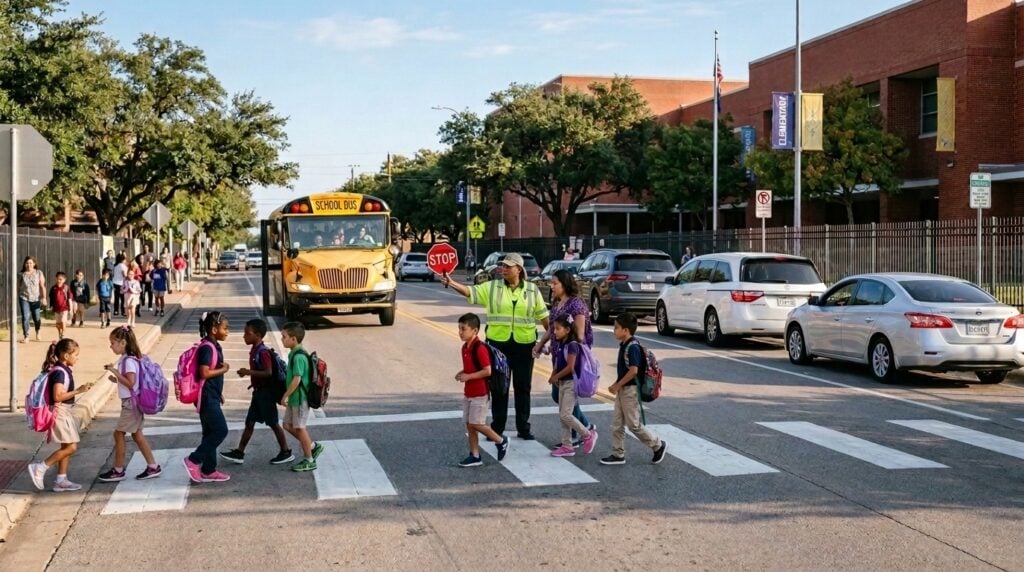
School zones are supposed to be the safest stretches of pavement in any neighborhood. Lower speed limits, flashing lights, crossing guards, and bright signage all exist for one reason: to protect kids. Yet these same areas remain some of the most dangerous places for pedestrians, precisely because of how crowded and chaotic they get during arrival and dismissal.
Key Takeaways
– School zone pedestrian accidents often involve driver behavior, including speeding, distraction, or failure to yield. Fault depends on the specific facts of the crash.
– Speeding, distraction, and failure to yield are the leading causes of these crashes.
– Texas law places heightened responsibility on drivers to protect kids in school zones.
– Some serious injuries, like concussions, may not show symptoms right away.
– Experienced legal help protects your family’s rights and your child’s recovery.
Why School Zones Are Uniquely Dangerous for Pedestrians
The danger in a school zone is not random. It is the product of several risk factors stacking up at the exact same time and place.
Start with sheer volume. During the roughly 30-minute windows before school starts and after it ends, an ordinary residential street can transform into a congested corridor packed with cars, buses, bicycles, and children on foot. Drivers grow impatient. Parking becomes a scramble. And in the middle of all of it, small children move unpredictably, sometimes darting between parked cars or stepping off a curb without looking.
Then there is the human factor behind the wheel. Many drivers passing through school zones are not parents dropping off kids at all. They are commuters using neighborhood streets as shortcuts, often glancing at phones, running late, and paying little attention to reduced speed limits. A driver going even ten miles per hour over the school zone limit dramatically increases both the likelihood of a crash and the severity of any resulting injury to a child.
Children themselves add another layer of risk, through no fault of their own. Young pedestrians have not fully developed the judgment to gauge vehicle speed and distance. They are shorter and harder to see, especially from the seat of an SUV or truck. And they are easily distracted, focused on friends or a dropped backpack rather than oncoming traffic. None of this makes an injured child responsible for a crash. It simply underscores why the law demands more care from drivers, not less.
The Most Common Causes of School Zone Pedestrian Accidents
While every crash has its own facts, most school zone pedestrian injuries trace back to a handful of driver behaviors. Understanding them helps families recognize when negligence played a role.
| Common Cause | Why It Leads to Pedestrian Injuries |
| Speeding | Higher speeds shorten reaction time and make injuries far more severe for a small pedestrian |
| Distracted driving | Texting, phone calls, or adjusting navigation pulls attention off crosswalks and children |
| Failure to yield | Drivers ignore pedestrians in crosswalks or roll through crossing areas without stopping |
| Illegal or reckless passing | Passing a stopped school bus or another stopped car hides children from view |
| Poor visibility choices | Blocking crosswalks, double-parking, or stopping in no-stop zones forces kids into traffic |
Speeding deserves special attention because of how physics works. Higher speeds give drivers less time to react and can greatly increase the risk and severity of pedestrian injuries. This is the entire reason school zone speed limits are lowered, and it is why drivers who ignore those limits carry such heavy responsibility when a child is hurt.
Failure to yield at crosswalks is another persistent problem. Many drivers treat marked crossings as suggestions rather than legal obligations, easing forward while a child is still in the road or turning without checking for pedestrians. When a driver fails to give the right of way that the law requires, and a child is struck as a result, that failure is often the heart of a negligence claim.
What Texas Law Requires in School Zones
Texas takes pedestrian safety around schools seriously, and the law reflects that. Drivers who enter a school zone take on heightened legal duties, and breaking those rules can serve as powerful evidence of negligence if a child is injured.
Reduced speed limits are the most familiar rule. When school zone lights are flashing or posted times are in effect, drivers must slow to the lower limit, often 20 miles per hour. Texas law also prohibits using a handheld cell phone while driving through an active school zone, recognizing that distraction and children are a deadly combination.
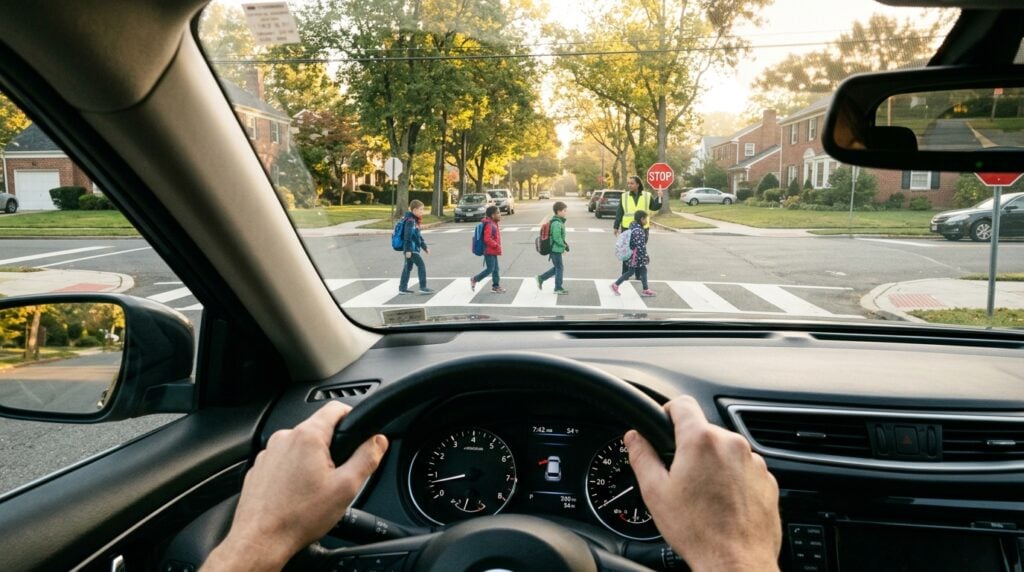
Drivers are further required to yield to pedestrians in crosswalks and to obey crossing guards and posted signs. Texas law generally prohibits drivers from passing a school bus that is stopped with its red lights flashing and stop arm extended. The rules can depend on the type of roadway, so drivers should always follow posted signs and applicable traffic laws. Each of these laws exists to build a protective bubble around children during the hours they are most exposed. When a driver violates one and a pedestrian is hurt, that violation frequently becomes central to establishing fault.
It is worth noting that these legal duties do not disappear simply because a child made a mistake, like stepping out unexpectedly. Texas follows a comparative fault system, which means responsibility can be shared, but a driver’s obligation to drive carefully in a school zone remains firmly in place.
Injuries Children Suffer in School Zone Accidents
Because pedestrians have no protection against the weight and force of a vehicle, school zone accidents involving children often produce serious, life-altering injuries. Even a low-speed impact can be devastating to a small body.
Common injuries include broken bones, head trauma and concussions, spinal injuries, internal organ damage, and severe cuts or road rash. Head and brain injuries are especially concerning in children, since the long-term effects can influence learning, behavior, and development for years to come. Some injuries are immediately obvious, while others, particularly concussions and internal injuries, may not fully reveal themselves until hours or days later.
This delayed onset is exactly why medical evaluation matters so much after any school zone incident. A child who seems shaken but “fine” at the scene should still be examined by a medical professional. Prompt care protects the child’s health first and also creates the documentation that becomes important if a legal claim follows.
What to Do If Your Child Is Injured in a Dallas School Zone
The moments after your child is struck are frightening and disorienting. Having a clear sense of what to do can protect both their recovery and your family’s ability to seek accountability.
Your first priority is always medical care. Call 911, get your child evaluated immediately, and follow through with every recommended follow-up, even if the injuries initially seem minor. From there, if you are able, try to document the scene by photographing the location, any crosswalks or signage, the vehicle, and the conditions around the crossing. Gather the driver’s information and the names and phone numbers of anyone who witnessed what happened, including other parents or crossing guards.
Be cautious with insurance companies. An adjuster may reach out quickly, sometimes sounding sympathetic while working to minimize the claim or secure an early statement that limits what the driver’s insurer has to pay. It is wise to speak with an attorney before giving recorded statements or accepting any settlement, because the full extent of a child’s injuries is not always clear in the early days. Above all, preserve everything: medical records, bills, photos, the police report, and any communication you receive about the crash.
How Frenkel & Frenkel Helps Families After a School Zone Accident
School zone pedestrian cases carry a particular emotional weight, and they also require careful legal work. Proving what happened often means reconstructing a chaotic scene, identifying which traffic laws were broken, locating witnesses before their memories fade, and documenting the true, long-term impact of a child’s injuries.
At Frenkel & Frenkel, our attorneys have spent decades helping injured Texans and their families pursue the accountability and compensation they deserve. In a school zone case, that means investigating whether a driver was speeding, distracted, or failed to yield, working with medical professionals to understand the full scope of a child’s injuries, and standing firm against insurance companies that would rather pay as little as possible.
What sets us apart:
– No Upfront Fees: You pay nothing unless we win your case.
– Clear Communication: We explain every step, every option, and every decision.
– Relentless Advocacy: We fight for the full compensation your family deserves.
– Compassionate Support: We treat you like family, not just another case number.
Protect Your Child and Your Family’s Rights
A school zone should be a place of safety, and when a driver’s carelessness shatters that safety, families deserve answers and accountability. Understanding why these accidents happen, what Texas law requires, and what steps to take can help you protect both your child’s recovery and your legal options.
If your child was hurt in or near a Dallas school zone, or if you were injured as a pedestrian, do not wait to learn about your options. Contact Frenkel & Frenkel today for a free, no-obligation consultation. Call us at (214) 333-3333 in Dallas or (817) 333-3333 in Fort Worth. Let us handle the legal pressure so you can focus on what matters most, which is helping your child heal.
Frequently Asked Questions
Q: Who is usually at fault in a school zone pedestrian accident?
A: In most cases, the driver bears responsibility, especially when speeding, distraction, or failure to yield played a role. Texas law places heightened duties on drivers in school zones, and violating those duties is often central to establishing fault.
Q: What if my child stepped into the road unexpectedly?
A: Texas uses a comparative fault system, so responsibility can be shared. However, a driver’s legal obligation to drive carefully and watch for children in a school zone does not go away simply because a child made a mistake.
Q: My child seemed fine after the accident. Should I still see a doctor?
A: Yes. Some serious injuries, including concussions and internal injuries, may not show symptoms right away. Prompt medical evaluation protects your child’s health and creates important documentation if you pursue a claim.
Q: How long do I have to file a claim in Texas?
A: Texas generally allows two years to file a personal injury claim, though the deadline can vary, particularly when a minor is involved. It is best to speak with an attorney as soon as possible to protect your rights.
Q: Should I talk to the driver’s insurance company?
A: Be cautious. Adjusters may seek early statements or offer quick settlements that do not reflect the full extent of your child’s injuries. It is wise to consult an attorney before giving recorded statements or accepting any offer.
Q: What compensation might be available after a school zone accident?
A: Depending on the facts, families may seek compensation for medical bills, future care, pain and suffering, and other losses. The specific value depends on the severity of the injuries and the details of the case.
https://maps.app.goo.gl/bcYsWLLgyTJJm2cX8
Created on 08-03-26